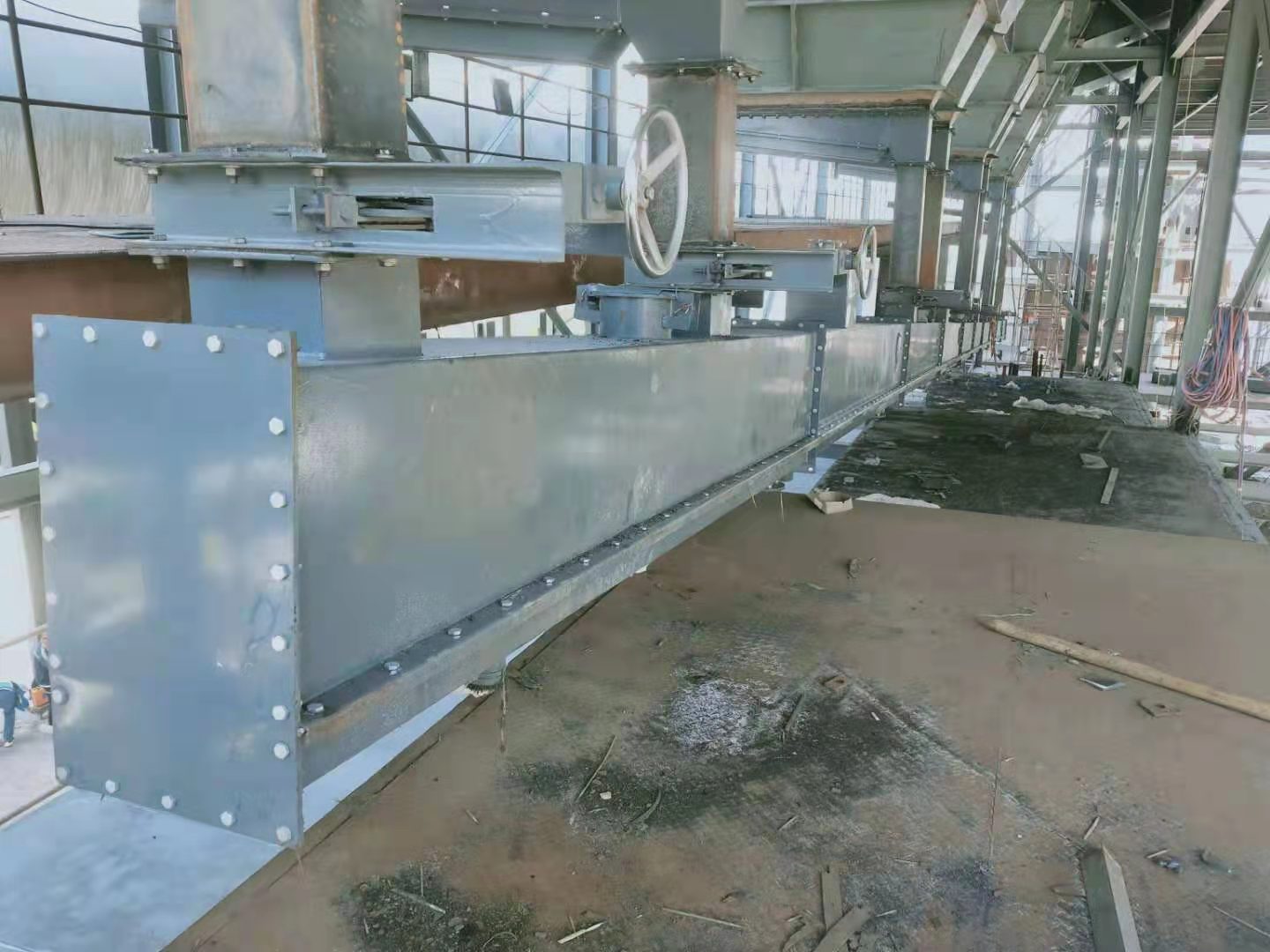



Air Conveying Inclined Chute
2026-08-03 15:52Air Conveying Inclined Chute
I. Overview
The air conveying inclined chute is one of the used for material conveying in industrial homogenization plants. It is suitable for conveying various dry powdery materials (such as cement and raw meal in the cement industry). Since the air inclined chute has moving parts during material conveying, compared with belt conveyors and screw conveyors, it has many advantages such as low wear, easy maintenance, low power consumption, material saving, no noise, sealing, safety and reliability, and ease of changing conveying direction, multi-point feeding, and discharging. Therefore, it has been adopted by many enterprises in recent years.
This equipment divided into eight specifications based on the width of the air inclined chute: B160, B200, B250, B315, B40, B500, B630, and B800. The material (cement) conveying capacity varies from 10 m³/h to 80 m³/h, making it suitable for various large, medium, and small enterprises to convey dry powdery materials.
II. Working Principle:
When conveying materials, the material fed into the upper chute body through the feeding inlet at the high end of the air inclined chute. Compressed air is blown into the lower chute body by a specially designed blower and uniformly among the material particles through a breathable layer, causing the material to undergo so-called fluidization. This changes the friction angle of the material, making it form a flowing state and down along the slope, then discharge through the discharge chute, thereby achieving the purpose of conveying.
III. Structural Shape and Dimensions:
The air conveying inclined chute consists of upper and lower chute bodies, arranged at a certain slope along its conveying direction. A breathable layer is sandwiched between the upper and lower chute bodies of the inclined chute. At the same time, to the requirements of different conveying lines, such as turning, reversing, slag cleaning, air cutting, and flow cutting, corresponding shaped inclined chute accessories are also designed.
1. The total length of the inclined chute includes the centerline length including the inclined chute accessories, which is determined by the process.
2. The length L of each standard inclined chute section is 3, and non-standard sections are 550 to 2500 mm.
3. The installation slope is selected by the process and can vary within 6 to 15°.
IV. Technical Performance:
1. Conveying Material
Dry powdery materials, with an allowable surface moisture of about 0.8%; otherwise, it will cause or even blockage.
2. Conveying Capacity
The conveying capacity of the inclined chute is affected by many factors and often varies greatly. Based on theoretical calculations, domestic and international reference, and comprehensive analysis of field investigations, we recommend the following for reference in conveying cement and raw meal at a 6° to 15° slope.
It is worth noting unlike other conveying machinery, if the conveying capacity is too low, the material often cannot be conveyed smoothly; conversely, increasing the material layer height can improve the uniformity of material fluid and the conveying capacity.
3. Slope
The slope of the inclined chute can vary within the range of 6° to 15°. Generally, if the surface moisture of conveyed material is large, a larger slope should be selected. If the installation space allows, adopting a larger slope is beneficial.
4. Air Volume
The air volume is affected factors such as the state of the material, the slope of the inclined chute, and the condition of the breathable layer. It can vary between 1.5 and 3 (³/min·m² of breathable layer), and generally, it can be considered as 2 (m³/min·m² of breathable layer).
5. Air Pressure
The pressure of the inclined chute is generally between 400 and 600 mm of water column. For large-specification long inclined chutes, a larger value should be taken